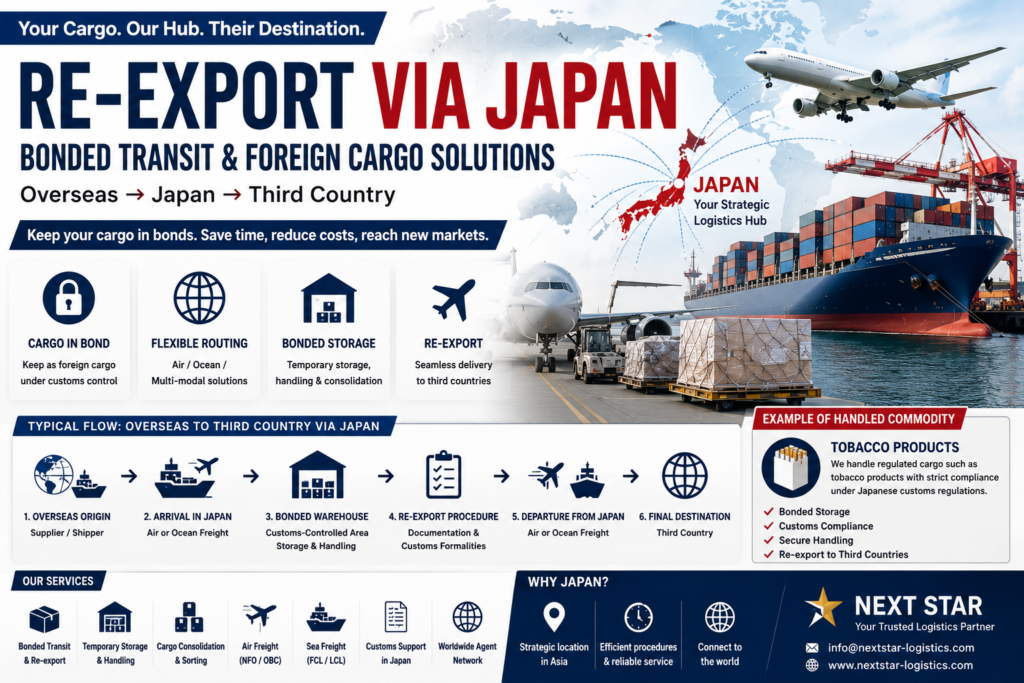
Japan is not only an import and export market—it can also function as a strategic logistics hub for international cargo moving between third countries.
For example:
Overseas Origin → Japan → Third Country
Cargo arrives in Japan from overseas, remains under customs control as foreign cargo, and is subsequently forwarded from Japan to another country without being imported into the Japanese domestic market.
At Next Star, we support international customers requiring bonded transit, temporary storage, cargo transfer and re-export arrangements via Japan.
This solution can be useful when cargo needs to be consolidated, temporarily stored, redirected, transferred between transportation modes or forwarded to a different overseas destination.
What Is Re-Export via Japan?
A typical international shipment follows a simple route:
Country A → Japan
The cargo arrives in Japan, completes import customs clearance, and enters the Japanese domestic market.
Re-export transit is different.
The logistics flow may instead be:
Country A
↓
Japan
↓
Bonded Storage / Transit Handling
↓
Re-Export
↓
Country B
The cargo is not intended for consumption or sale in Japan.
Instead, Japan functions as an intermediate logistics point before the cargo continues to its final destination.
Keeping Cargo as Foreign Cargo in Japan
One of the most important concepts in this type of operation is the customs status of the cargo.
Cargo arriving from overseas may be handled under customs control without immediately being released into the Japanese domestic market.
In Japan, cargo that has not received import permission is generally treated as foreign cargo.
Depending on the operation, it can be moved to an appropriate bonded facility and held under customs control before being re-exported.
This makes it possible to use Japan as an international logistics hub without necessarily importing the goods into the Japanese market.
Why Use Japan as a Transit and Re-Export Hub?
There are many situations where an international company may need cargo to pass through Japan before reaching another country.
For example:
Cargo Consolidation
Products arriving from different origins can potentially be coordinated in Japan before onward transportation.
Temporary Storage
The final destination may not yet be ready to receive the cargo.
Temporary bonded storage can provide additional flexibility.
Change of Destination
The original destination may change after the cargo has already departed from the origin.
Japan may be used as an intermediate point before arranging onward transportation.
Air-to-Air / Sea-to-Air / Air-to-Sea Transfer
Depending on the cargo and routing, different transportation modes may be combined.
Examples include:
Ocean → Japan → Air
or
Air → Japan → Ocean
International Distribution
Companies managing inventory for multiple Asian or global markets may require a logistics point from which cargo can be redirected to different destinations.
Example: Overseas → Japan → Third Country
A typical operation may look like this:
Overseas Supplier
↓
International Air or Ocean Freight
↓
Arrival in Japan
↓
Customs-Controlled Handling
↓
Bonded Warehouse
↓
Temporary Storage / Cargo Handling
↓
Re-Export Documentation
↓
Air or Ocean Freight
↓
Third Country
The exact customs procedure depends on the cargo, arrival method, departure method, storage location and other conditions.
Therefore, each shipment should be reviewed individually before transportation begins.
Bonded Warehouse Arrangements in Japan
Bonded facilities play an important role in re-export logistics.
Instead of immediately importing the cargo into Japan, eligible cargo can be handled at an appropriate customs-controlled facility while awaiting its next international movement.
Depending on the project, required operations may include:
- Cargo receiving
- Temporary storage
- Inventory confirmation
- Package count verification
- External condition checks
- Cargo photographs
- Sorting
- Relabeling
- Repacking
- Palletizing
- Consolidation
- Preparation for onward transportation
Whether a particular operation is permitted depends on the applicable customs procedure and facility.
This should always be confirmed before the cargo arrives in Japan.
Air Freight Transit via Japan
Japan can also be used as an intermediate point for international air cargo.
For example:
Europe → NRT → Southeast Asia
or
Asia → NRT/KIX → North America
Depending on airline schedules, cargo requirements and customs procedures, Japan may serve as a transit or re-forwarding point.
For urgent shipments, we can also investigate time-critical onward transportation.
Ocean Freight Re-Export via Japan
The same concept can apply to ocean freight.
For example:
Country A → Yokohama
↓
Bonded Handling in Japan
↓
Country B
Depending on the shipment, onward transportation may be arranged by:
- FCL
- LCL
- Air Freight
- Special Equipment
- Other multimodal solutions
The optimal arrangement depends on cargo volume, destination, required delivery date and customs requirements.
Sea-to-Air and Air-to-Sea Solutions
One particularly useful application is changing transportation modes in Japan.
For example:
Sea-to-Air
Origin → Japan by Ocean Freight → Third Country by Air Freight
This may be considered when cargo originally moving by ocean needs to be accelerated for the remaining journey.
Air-to-Sea
Origin → Japan by Air Freight → Third Country by Ocean Freight
This may be considered when the first part of the shipment is urgent but the remaining transportation can move more economically by sea.
These solutions require careful coordination between terminals, bonded facilities, customs procedures and carriers.
Handling Regulated and Sensitive Commodities
Re-export shipments sometimes involve commodities subject to additional regulations or controls.
One example from our actual operations is tobacco products moving through Japan for onward transportation to another country.
Tobacco is a regulated commodity, so its handling cannot be treated in the same way as ordinary general cargo.
Depending on the shipment, additional requirements may apply regarding:
- Customs procedures
- Bonded storage
- Taxes and duties
- Licensing or approvals
- Documentation
- Carrier acceptance
- Destination-country regulations
For this reason, regulated commodities must always be reviewed on a case-by-case basis before shipment.
The fact that cargo is only transiting Japan does not automatically mean that all regulatory requirements are waived.
Japan Is the Transit Point — Not the Final Market
This distinction is particularly important.
The commercial intention is not:
Overseas → Import into Japan → Sell in Japan
but rather:
Overseas → Japan as Logistics Hub → Re-Export Overseas
Keeping these two transactions clearly separated is important when planning customs procedures, documentation and storage arrangements.
Documentation for Re-Export Shipments
Required documents depend on the commodity and routing, but commonly requested information includes:
- Commercial Invoice
- Packing List
- Air Waybill / Bill of Lading
- Country of Origin
- Commodity Description
- HS Code
- Quantity
- Gross / Net Weight
- Cargo Value
- Origin
- Final Destination
For regulated commodities, additional documentation may be required.
We recommend reviewing the complete shipping flow before the cargo departs from the origin country, rather than after it arrives in Japan.
Why Planning Before Arrival Is Important
Bonded transit and re-export shipments require more preparation than standard imports.
Before the cargo departs for Japan, it is important to confirm:
1. Where will the cargo arrive?
2. Where will it be stored?
3. What customs status will be used?
4. What handling is required in Japan?
5. How will it leave Japan?
6. What is the final destination?
7. Are there any commodity-specific restrictions?
If these points are not confirmed beforehand, cargo may arrive in Japan without an appropriate facility or onward transportation plan.
Next Star – Re-Export & Bonded Transit Logistics in Japan
Next Star can coordinate international cargo moving through Japan to third countries.
Our services include:
- Re-Export via Japan
- Bonded Transit Coordination
- Foreign Cargo Handling
- Bonded Warehouse Arrangement
- Temporary Storage
- Cargo Consolidation
- Cargo Sorting
- Repacking / Palletizing
- Air Freight
- Ocean Freight
- Sea-to-Air
- Air-to-Sea
- Export / Re-Export Customs Coordination
- Third-Country Transportation
- Time Critical Logistics
- Worldwide Agent Coordination
We work with customers and overseas logistics partners to design the complete transportation flow from origin through Japan to the final destination.
Looking for a Re-Export Hub in Japan?
If your cargo needs to arrive in Japan from one country and then continue to another country, you may not need to import the goods into the Japanese domestic market.
Depending on the cargo and customs requirements, it may be possible to keep the shipment under customs control and arrange onward transportation as foreign cargo.
The key is to design the logistics flow correctly before the shipment reaches Japan.
Please provide:
Origin Country
→ Arrival Airport / Port in Japan
→ Commodity
→ Number of Packages / Weight / Dimensions
→ Required Handling in Japan
→ Final Destination Country
and Next Star can review the appropriate logistics arrangement.
Country A → Japan → Country B
Japan can be more than a destination.
It can be your international logistics hub.