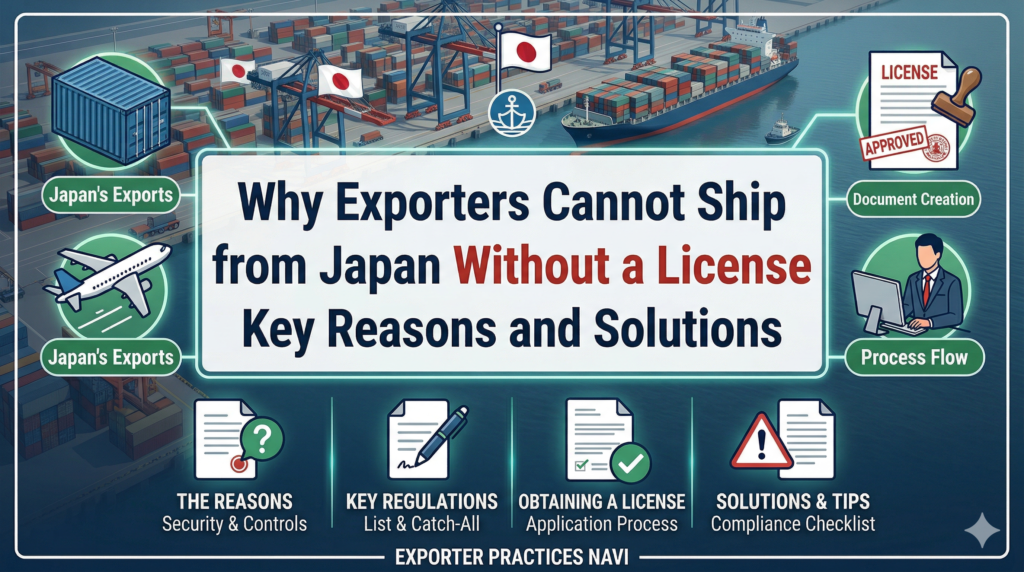
When sourcing products from Japan, overseas buyers often face an unexpected issue:
👉 “The exporter cannot ship the cargo due to licensing or compliance reasons.”
This is a common situation in international trade, especially when dealing with controlled goods, machinery, electronics, or automotive parts.
In this article, we explain the main reasons why exports from Japan may be blocked and, more importantly, how to solve these problems efficiently.
■ Main Reason 1: No Legal Entity in Japan
One of the biggest obstacles is:
👉 The exporter does not have a registered legal entity in Japan
Why this matters:
- Export procedures must be handled by a Japan-based entity
- Only a local company can:
- Act as the Exporter of Record
- Handle customs clearance
- Take responsibility for compliance with Japanese laws
Result:
Without a Japanese entity, the shipment cannot legally proceed.
■ Main Reason 2: Inability to Issue a Non-Applicable Certificate
Another critical issue is:
👉 The exporter cannot provide a Non-Applicable Certificate under Japan’s Export Trade Control Order
What is this?
A Non-Applicable Certificate confirms that:
- The product is not subject to export control regulations
- The goods are not intended for military or restricted use
Why this is required:
- Japanese export regulations (Foreign Exchange and Foreign Trade Act)
- Customs and forwarders often require this document
- Especially important for:
- Machinery
- Electronic components
- Precision equipment
- Automotive parts
Result:
If this document cannot be issued,
👉 the cargo may be rejected or held at export stage
■ Additional Risk: Compliance Uncertainty
Even if the shipment seems simple, exporters may stop the process due to:
- Lack of knowledge about export control regulations
- Fear of legal violations
- No internal compliance system
👉 In Japan, compliance is taken very seriously, and companies prefer to stop shipments rather than risk violations
■ Solutions: How to Overcome These Issues
1. Use a Japan-Based Export Partner
Work with a company that:
- Is legally registered in Japan
- Can act as Exporter of Record
- Has experience in export compliance
2. Properly Handle Export Control Documentation
A professional partner can:
- Prepare Non-Applicable Certificates
- Support classification (HS code / control list)
- Conduct compliance checks
3. Integrate Logistics and Compliance
The most effective solution is to work with a partner who can handle:
- Export documentation
- Customs clearance
- International transportation (Air / Sea)
👉 This minimizes delays and reduces risk
■ Conclusion
Exports from Japan may be blocked mainly due to:
- Lack of a legal entity in Japan
- Inability to issue a Non-Applicable Certificate
- Compliance-related concerns
However, these issues are fully solvable with the right partner.
■ We Can Handle Everything for You
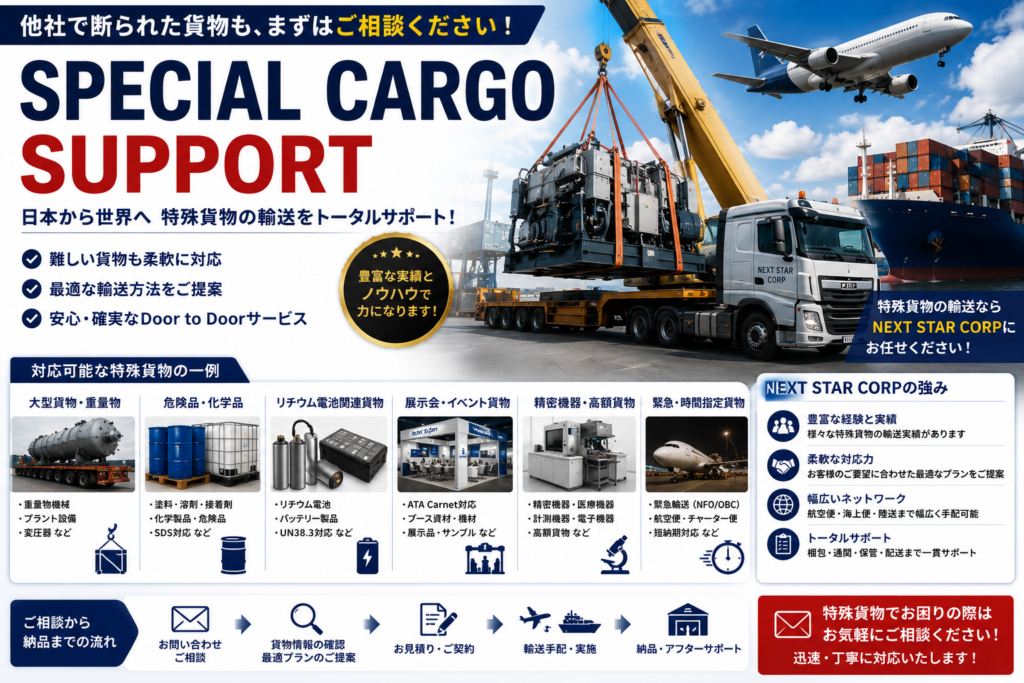
We provide full support including:
- Acting as Exporter of Record in Japan
- Preparation of Non-Applicable Certificates
- Export customs clearance
- International freight (Air / Sea / Hand Carry)
👉 From documentation to final delivery, we handle the entire export process on your behalf.
Please feel free to contact us for smooth and compliant exports from Japan.