Procedures, Regulations, HS Codes, Inspections, and a Practical Risk-Reduction Method
Many overseas shippers and freight forwarders face
the same issue when shipping to Japan:
-
“Why was the cargo stopped by quarantine?”
-
“Why are additional documents suddenly required?”
-
“Why are food items and tableware treated so differently?”
The key point is this:
Food products and tableware may look
similar as kitchen goods, but under Japanese
import regulations, they are handled through
completely different procedures.
Understanding this difference before
shipment is critical to avoiding delays, storage costs,
inspections, and rejected cargo.
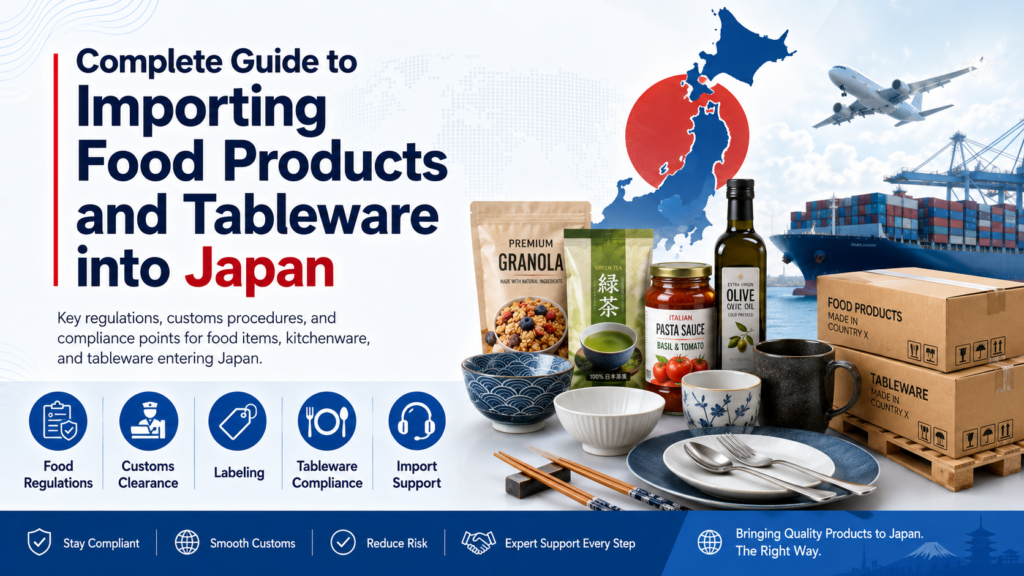
This guide explains the practical requirements
for importing food products and tableware into Japan,
the common trouble points,
HS codes, and a highly effective
risk-reduction method used by experienced importers.
Importing Food Products into Japan (Quarantine Requirement)
Food products are strictly
regulated under Japan’s Food Sanitation Act.
Before customs clearance, an
Import Notification for Food, etc.
must be submitted to the Quarantine Station at the port or airport of arrival.
Depending on the product, authorities may require:
-
Ingredient analysis
-
Additive confirmation
-
Microbiological testing
-
Manufacturing process details
-
Temperature control records (for frozen/chilled cargo)
-
Japanese compliant labeling (allergens, additives)
Required Documents
-
Import Notification for Food
-
Ingredient list and manufacturing flow chart
-
Raw material certificate
-
Product label data for Japanese compliance
-
Temperature records (if applicable)
Without these, the shipment can be held for inspection.
Importing Tableware into Japan (Utensils & Containers Regulation)
Tableware is not classified as food.
However, because it comes into contact
with the mouth, it is regulated under the same
Food Sanitation Act as utensils and food-contact materials.
Authorities may require leaching tests depending on the material.
Typical Tests by Material
| Material | Possible Required Test |
|---|---|
| Ceramic / Porcelain / Glass | Lead & Cadmium leaching test |
| Stainless steel | Heavy metal test |
| Plastic | BPA and chemical leaching test |
| Wooden tableware | Chemical treatment check, possible plant quarantine |
Many shipments are delayed simply
because the material certificate
was not prepared before shipping.
Key Difference Between Food and Tableware
| Item | Food Products | Tableware |
|---|---|---|
| Authority | Quarantine Station | Quarantine Station (utensil category) |
| Notification | Mandatory | Case-by-case |
| Inspection | Ingredients / bacteria / additives | Material leaching test |
| Japanese Label | Mandatory | Not required |
| Typical HS Range | Chapter 2–21 | Chapters 39 / 69 / 70 / 73 |
Frequently Seen HS Codes
| Product | HS Code |
|---|---|
| Instant noodles | 1902.30 |
| Confectionery | 1905.90 |
| Soy sauce / seasonings | 2103.10 |
| Ceramic plates | 6911.10 |
| Glass cups | 7013.37 |
| Stainless tableware | 7323.93 |
| Plastic food containers | 3924.10 |
Common Trouble Cases at Japanese Ports
-
Food and tableware shipped together → entire cargo held
-
Missing ingredient or material documentation → inspection order
-
Non-compliant label → cannot be sold in Japan
-
Wooden tableware → unexpected plant quarantine
-
Large sea shipment stopped → heavy storage and demurrage cost
A Practical Risk-Reduction Method: Start with a Small Air Shipment
One highly effective solution used by experienced importers is:
First ship a small quantity by air.
This allows:
-
Minimal damage if inspection is ordered
-
Verification that documents and labels are acceptable
-
Establishing a successful quarantine & customs clearance record
-
Quick feedback within days instead of weeks
-
Safe preparation before moving to sea freight in volume
This “test shipment” method significantly reduces the risk of large financial loss.
Recommended Safe Flow
-
Obtain ingredient list / material certificate / label data before shipment
-
Ship a small quantity by air
-
Confirm quarantine and customs process
-
Correct any issues found
-
Proceed with full sea shipment confidently
Conclusion
Importing food products and tableware into Japan requires more preparation than many overseas shippers expect.
Most problems occur
before the cargo even leaves origin
due to missing documentation or
misunderstanding of Japanese regulations.
Following the correct order —
especially using a small air shipment first —
can prevent costly delays and cargo holds.
Consultation for Food Imports into Japan
We provide support for overseas shippers
and freight forwarders handling food cargo to Japan, including:
-
Pre-shipment document checks (ingredients, labels, materials)
-
Advice on quarantine requirements
-
Arrangement of small test air shipments
-
Smooth transition to full sea freight once cleared
If you are unsure whether your cargo is compliant for Japan,
feel free to consult us before shipment.