Temperature controlled air freight requires more than simply booking a flight.
For products such as reagents, pharmaceuticals, diagnostic materials,
laboratory samples, and medical-related cargo, maintaining
the correct temperature range throughout the logistics chain is critical.
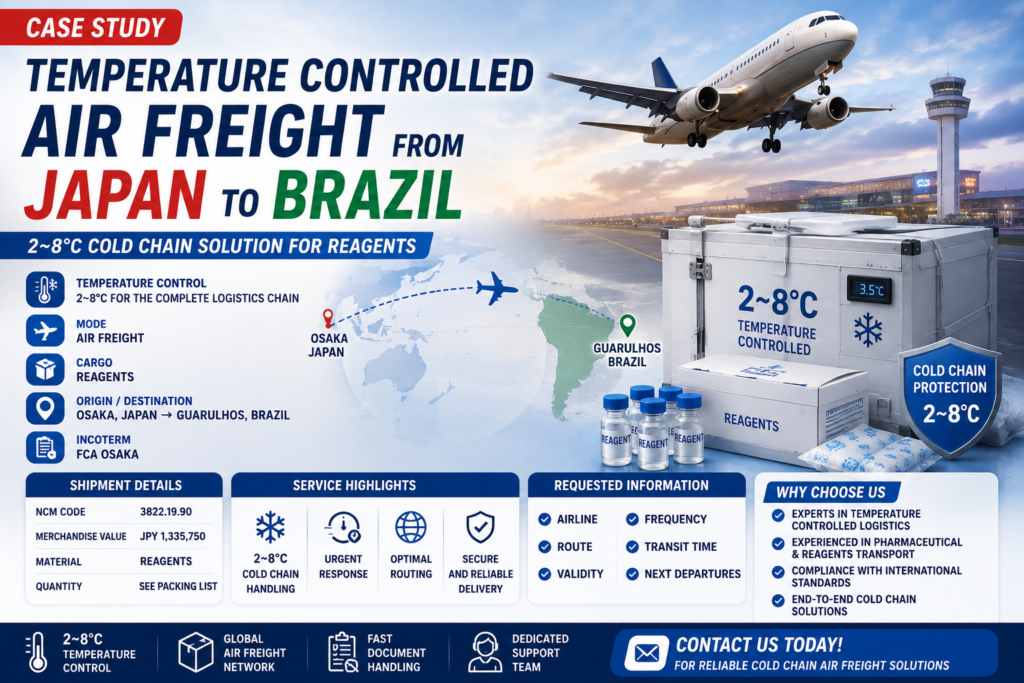
This article explains the key points of 2–8°C cold chain air freight from Japan to Brazil,
especially for shipments moving from Japan to Guarulhos, Brazil,
one of the major air cargo gateways in South America.
If you are arranging temperature sensitive cargo from Japan,
the following points will help you reduce risk and plan the shipment more safely.
What Is 2–8°C Temperature Controlled Air Freight?
2–8°C temperature controlled air freight is a logistics
service designed to keep cargo within a refrigerated temperature range during transportation.
This temperature range is commonly required for:
- Reagents
- Diagnostic kits
- Medical products
- Pharmaceutical products
- Biotech materials
- Laboratory supplies
- Clinical trial materials
- Temperature sensitive chemicals
- Research samples
For these products, even a short temperature deviation can affect quality, performance, or compliance.
That is why the entire logistics process must be planned carefully, from pickup in Japan to arrival handling at the destination.
Why Cold Chain Logistics Is Important
Cold chain logistics protects products that are sensitive to temperature change.
For 2–8°C cargo, the risk is not only during the international flight. Temperature deviation can happen at many points, including:
- Pickup from the shipper
- Waiting time before airport delivery
- Export warehouse handling
- Airline terminal handling
- Flight connection
- Transit airport storage
- Arrival terminal handling
- Import customs process
- Final delivery to consignee
A reliable cold chain shipment requires control and coordination across all these stages.
Typical Shipment Example: Japan to Brazil
A typical 2–8°C cold chain shipment from Japan to Brazil may involve the following conditions:
| Item | Example |
|---|---|
| Origin | Osaka, Japan |
| Destination | Guarulhos, Brazil |
| Cargo | Reagents / medical-related products |
| Temperature Range | 2–8°C |
| Transport Mode | Air Freight |
| Incoterm | FCA or EXW depending on arrangement |
| Key Requirement | Temperature control throughout the logistics chain |
For Japan to Brazil shipments, route selection and transit handling are especially important because there may be long transit times and connecting flights.
Key Points for Successful 2–8°C Air Freight
1. Confirm the Required Temperature Range Clearly
Before booking, the required temperature range must be confirmed in writing.
For example:
Required temperature: 2–8°C throughout the logistics chain
This information should be shared with:
- Shipper
- Forwarder
- Trucking company
- Airline
- Customs broker
- Destination agent
- Consignee
If the temperature instruction is unclear, the cargo may be handled as general cargo, which creates serious risk.
2. Check Whether the Cargo Is DG or Non-DG
Reagents and medical-related products may sometimes fall under dangerous goods regulations.
Before shipment, it is important to confirm whether the cargo is:
- Non-DG
- DG cargo
- Excepted quantity
- Dry ice shipment
- Temperature controlled but non-hazardous
- Subject to special airline approval
Documents such as SDS / MSDS may be required to confirm the classification.
If the cargo is DG, airline acceptance, packing, labeling, documentation, and routing options may be more limited.
3. Use Proper Cold Chain Packaging
Packaging is one of the most important parts of temperature controlled logistics.
Depending on the product and transit time, the cargo may require:
- Validated thermal box
- Insulated carton
- Gel packs
- Refrigerant packs
- PCM packs
- Dry ice, if applicable
- Temperature logger
- Temperature indicator
- Outer carton labeling
- Shock protection
- Waterproof protection
The packaging must be suitable for the expected transportation time, including possible delays at origin, transit, and destination.
For international air freight, it is not enough to calculate only the flight time. The packaging should also cover airport handling time and unexpected waiting time.
4. Confirm How Long the Packaging Can Maintain 2–8°C
Every cold chain package has a temperature holding time.
Before shipment, confirm:
- How many hours the package can maintain 2–8°C
- Whether the validation covers expected ambient temperature
- Whether the cargo may be exposed to high temperature
- Whether re-icing or refrigerant replacement is possible
- Whether the route has long transit time
- Whether weekend or holiday delay may occur
For long-haul routes such as Japan to Brazil, the holding time must be checked very carefully.
5. Choose the Right Airline and Route
For temperature controlled cargo, the cheapest route is not always the best route.
The route should be selected based on:
- Total transit time
- Airline cold chain capability
- Connection airport condition
- Availability of temperature controlled storage
- Cargo acceptance deadline
- Flight frequency
- Risk of offload
- Destination handling capability
- Arrival time and customs schedule
A shorter and more reliable route is often better than a low-cost route with a high risk of delay or long transit.
6. Check Cold Storage Availability
For 2–8°C cargo, cold storage availability is essential.
Cold storage may be needed at:
- Origin airport
- Transit airport
- Destination airport
- Forwarder warehouse
- Airline terminal
- Customs bonded facility
Before shipping, confirm whether refrigerated storage is available and whether the cargo can be handled according to the required temperature range.
If cold storage is not available at a transit point, the route may not be suitable.
7. Prepare Accurate Documents
Temperature controlled cargo often requires more documents than normal cargo.
Typical documents may include:
- Commercial Invoice
- Packing List
- Air Waybill instructions
- SDS / MSDS
- Product specification
- Temperature handling instruction
- Non-DG declaration, if applicable
- DG declaration, if applicable
- Certificate of analysis, if required
- Import permit or consignee instruction
- HS code / NCM code
- End-use or product explanation, if required
For Brazil-bound cargo, destination import requirements should be checked with the consignee or local broker before export.
Important Documents for Reagents Shipping
For reagents, the following information should be checked before booking:
Product Description
The product name should be clear enough for airline, customs, and destination handling.
Avoid vague descriptions such as:
- Chemical goods
- Medical item
- Samples
- Reagents only
A more detailed description helps reduce questions and delays.
SDS / MSDS
SDS is often required to confirm whether the cargo is dangerous goods.
If the product is non-DG, the airline or forwarder may still request supporting documentation.
Temperature Instruction
The required temperature range should be clearly shown:
Keep refrigerated at 2–8°C
This instruction should be consistent across documents and labels.
Packing Information
The packing method should be explained, especially if the cargo uses thermal boxes, gel packs, dry ice, or temperature loggers.
Common Risks in Temperature Controlled Air Freight
Temperature Deviation
This is the biggest risk. It can occur due to improper packing, long waiting time, lack of cold storage, flight delay, or incorrect handling.
Flight Delay or Offload
If the cargo is offloaded or delayed, the packaging holding time may not be enough.
Wrong Route Selection
A route with long transit or poor cold chain handling may increase risk.
Incomplete Documents
Missing SDS, unclear product description, or incorrect temperature instructions can delay airline acceptance.
Weekend or Holiday Delay
If the cargo arrives during a weekend or holiday, import clearance or final delivery may be delayed.
Lack of Destination Preparation
The consignee or destination broker must be ready to handle the cargo immediately after arrival.
Practical Checklist Before Shipping
Before arranging 2–8°C air freight from Japan, check the following:
- Is the cargo DG or non-DG?
- Is SDS / MSDS available?
- What is the exact required temperature range?
- How long can the packaging maintain 2–8°C?
- Is a temperature logger required?
- Is cold storage available at origin?
- Is cold storage available at transit airport?
- Is cold storage available at destination?
- What is the airline acceptance deadline?
- What is the total transit time?
- Are import documents ready at destination?
- Can the consignee receive the cargo immediately?
- Is weekend or holiday delay possible?
- Is there a backup route if the planned flight is unavailable?
This checklist helps reduce risk before the cargo leaves Japan.
Why Japan-Side Coordination Matters
For temperature controlled cargo from Japan, local coordination is extremely important.
The Japan-side operation may include:
- Pickup from shipper
- Temperature controlled trucking
- Export document checking
- Airport delivery
- Airline booking
- Export customs coordination
- Cold storage arrangement
- AWB instruction
- Flight monitoring
If the cargo is not handled properly at the origin, the entire cold chain may be affected.
A reliable Japan-side logistics partner can help coordinate the shipment from the beginning and reduce the risk of temperature deviation.
Who Needs This Service?
Temperature controlled air freight from Japan is suitable for companies handling:
- Pharmaceutical products
- Reagents
- Diagnostic kits
- Medical equipment
- Biotechnology materials
- Laboratory samples
- Research products
- Clinical trial materials
- Temperature sensitive chemicals
- Healthcare-related products
It is also useful for overseas freight forwarders who need a reliable Japan-side partner for cold chain air cargo.
Support Available for 2–8°C Air Freight from Japan
For temperature sensitive cargo, support may include:
- 2–8°C air freight arrangement
- Cold chain route planning
- Airline schedule checking
- Temperature controlled pickup
- Cold storage coordination
- Export customs support
- Document checking
- SDS / MSDS confirmation
- DG or non-DG confirmation support
- AWB instruction
- Transit time confirmation
- Destination agent coordination
- Urgent quotation support
Contact Us for Temperature Controlled Air Freight from Japan
If you need to ship reagents, pharmaceuticals, medical products, or other temperature sensitive cargo from Japan, early coordination is essential.
Please provide the following information:
- Origin in Japan
- Destination airport
- Cargo description
- Required temperature range
- DG or non-DG status
- SDS / MSDS
- Number of packages
- Dimensions and gross weight
- Packing method
- Ready date
- Required delivery deadline
- Invoice and packing list
- Consignee contact information
We will review the cargo condition, available routes, airline options, transit time, and cold chain handling requirements.
Need 2–8°C temperature controlled air freight from Japan? Contact us today for reliable cold chain logistics support.